Join real people.
You are not alone.
Your data stays inside.
Now it is your turn.
10TH JULY 2021: SOUND PICTURES CONFERENCE
Details
| Date & time | Jun 10 '21 |
| Location | King's College London, United Kingdom |
| Creator | Jefferson |
| Category |
Who's attending
 PRO
Description
Pre-watch materials online 10th June 2021
Live keynote + Q&A 10th July 2021
The British Society of Aesthetics is delighted to sponsor Sound Pictures
The British Society of Aesthetics is delighted to sponsor Sound Pictures, a conference bringing together theorists, researchers, and postgraduates from within philosophy to explore the topic of multi-sensory appreciation of the arts.
Call for Abstracts
Sound Pictures
King’s College London
10th July 2021 (on Zoom)
The Theme
Imagine a sculpture made to be heard, or a picture that can be played on a banjo. Although many artworks are multi-sensory in the sense that they invite appreciation by sight, sound, movement and even touch (e.g film and immersive theatre) it might seem odd to say a simple drawing is genuinely multisensory. We don’t expect a drawing to look like the taste of strawberries, just as we don’t expect warm vanilla to taste like triangles.
This expectation carries over to appreciation. It is natural to think that when your friend remarks on a painting they will say something about how it looks, rather than how it sounds. But, given that multi-sensory appreciation is held to be ‘the rule and not the exception in perception’ (Shimojo and Shams, 2001) do we ever appreciate a work with a single sensory mode? Does adequate appreciation of (apparently) single sensory artworks (for example, a painting) require input from the other senses?
Confirmed Speakers
Mitchell Green (UCONN)
Derek Matravers (OU)
Jenny Judge (NYU)
Natalie Bowling (Goldsmiths)
Jason Leddington (Bucknell)
About cross-sensory artforms and graphic notations
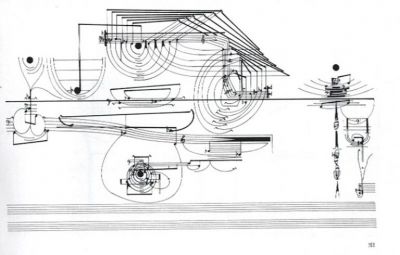
Several art-forms speak to the question of multisensory confusion, integration and enhancement. For instance, the concept of music is fundamental to Kandinsky’s work. He believed one should ‘see’ his paintings aurally. Likewise, Goethe declared that architecture was “frozen music”. An example pertinent to philosophical reflection is that of graphic notation, where a piece of music is ‘directly depicted’ rather than written down in conventional musical notation. Visual works of art to be appreciated musically were brought to public attention by Earle Brown and John Cage. The experimental movement reached a peak with Cornelius Cardew’s Treatise (1963-1967).
Important Dates
Registration for Conference 1 June 2021
Pre-watch materials online 10 June 2021
Live keynote + Q&A 10th July 2021
Organising Committee
Vanessa Brassey
Jørgen Dyrstad
Giulia Corti
Contact
For any and all enquiries, please contact the organisers through [email protected]


The Wall