Join real people.
You are not alone.
Your data stays inside.
Now it is your turn.
Contemporary Approaches to Research Symposium
Details
| Date & time | Nov 22 '21, 09:00AM |
| Ends on | Nov 23 '21, 05:00PM |
| Location | Deakin University (Geelong Waurn Ponds Campus), Australia |
| Creator | gwaters |
| Category | symposium |
Who's attending
 PRO
PRO
Description
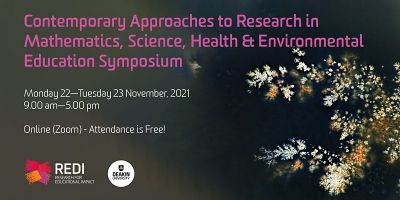
A two-day online symposium focussing on practical & theoretical aspects of a range of research methodologies.
Registration website
About this event
Each year the ‘Contemporary approaches to research (CAR) in mathematics, science, health and environmental education’ symposium focuses on practical and theoretical aspects of a range of research methodologies – such as cross-cultural perspectives, activity theory, capturing complexity, classroom video analysis, quantitative methods, and interviewing – which are discussed in a lively, informal setting.
The symposium in 2021 will be held online (via Zoom), and will focus on practical and theoretical aspects of research methodology (as usual) and this year we are broadening our methodological focus to include the (new) materialists.
The program will include two keynote speakers and the themed sessions. See the Keynotes introduced below….
The program starts at 9am and concludes at 5pm each of the two days.
Presentations at the symposium will be grouped into sessions of two to four with similar methodological foci, designed to promote substantive discussion of a methodological issue. Presentations might focus on a) details and settings of the application of a methodology in ways that unpack how the methodology can operate in different contexts, or b) a particular methodological issue, problem, or strategic decision that explores or extends a methodology.
The methodological issues should be broadly related to mathematics, science, health, or environmental education. The presentations should provide a grounded practitioner’s perspective.
Following each group of presentations, there will be the opportunity for extended discussion of the focus methodological issue, which may explore different approaches within the methodology (in research design, instruments, theoretical framing, or approaches to analysis), or different methodological approaches to a problem (for instance making sense of teacher practice, or tracking change in learners).
Presentations will be 10-12 minutes in duration and should briefly outline the research question being addressed and may include the findings or likely outcomes of the research, but should focus mainly on the research methodology. Reports on work in progress are welcome but the focus is on the methodology
Keynote Speakers
Paul Hart
Paul Hart is Professor Emeritus and Adjunct Professor of Science and Environmental Education at the University of Regina, Canada. He has authored and edited many books and journal articles, served on Canadian research awards selection committees and received local, regional, national and international awards for his publications, research, and leadership in the fields of education and environmental education. He has served as Executive Editor of the Journal of Environmental Education and on editorial boards for EE journals in several countries.
Robin Bellingham
Dr Robin Bellingham is a Lecturer in Education, Pedagogy and Curriculum at Deakin University. In her research and teaching she is interested in how methodologies and education can respond to pressing problems of modernity such as educational and political disempowerment and disengagement, the ongoing effects of colonisation, and ecological crisis. Her research has explored these through different enactments and analyses of educational, democratic and ecological agency, and examination of the ethics and values that emerge through these in different contexts. She draws on different writing genres, post-humanism, and new materialism.
Submit an Abstract
If you are interested in presenting at
this symposium please register your expression of interest before Friday
1 October 2021 on the Re-Imagining Futures in STEME website (deakinsteme.org) which provides online submission.
Presentations should be no longer than 12 minutes in duration (further details will be provided upon acceptance of your proposal). Presentations should briefly outline the research question being addressed, and may include the findings or likely outcomes of the research but should focus mainly on the research methodology. Reports on work in progress are welcome.
All presenters are invited to submit a proposal for a written chapter of 5000 – 7000 words for consideration for publication in the Cambridge Scholars Publishing book series Contemporary Approaches to Research in STEM Education. Proposal are due 26th November 2021. Accepted chapters are due 19th February 2022.


The Wall