Join real people.
You are not alone.
Your data stays inside.
Now it is your turn.
Moving for Marriage
Details
| Date & time | Mar 3 '22, 04:00PM |
| Ends on | Mar 3 '22, 05:30PM |
| Location | The University of Edinburgh, United Kingdom |
| Creator | gwaters |
| Category | webinar |
| Registration | Link |
Who's attending
 PRO
Description
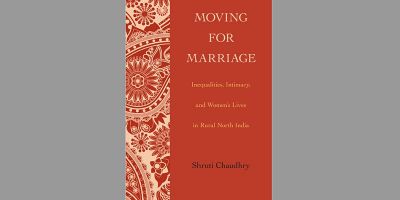
sponsored by Centre for South Asian Studies and CRFR;
author talks with experts on Indian & marriage, Professor
Charsley, Mody & Abraham
Author Bio: Shruti Chaudhry is British Academy Postdoctoral Fellow in Sociology at the University of Edinburgh. Her current research focuses on experiences of ageing and care among the South Asian diaspora in Scotland. The book being discussed is based on research carried out in north India for her PhD awarded by the University of Edinburgh.
Chair: Professor (Emerita) Patricia Jeffery, Sociology, University of Edinburgh
Discussants: Professor Katharine
Charsley, Sociology, University of Bristol
Dr Perveez Mody, Associate Professor, Social Anthropology, University of Cambridge
Professor Janaki Abraham, Sociology, Delhi School of Economics, University of Delhi
Book abstract: Drawing on ethnographic fieldwork in rural Uttar Pradesh, Moving for Marriage compares the lived experiences of women in “regional” marriages (that conform to caste and community norms within a relatively short distance) with women in “cross-regional” marriages (that traverse caste, linguistic, and state boundaries and entail long-distance migration within India). By distinguishing where geographic distance and regional origins make a difference in these women’s experiences, this book challenges stereotypes and moral panics about cross-regional brides who are brought from far away. Moving for Marriage highlights the ways in which the post-marital experiences of both categories of wives in this study—their work and social relationships, their sexual lives and childbearing decisions, and their ability to access support in everyday contexts and in the event of marital distress—are shaped by a range of factors that include caste, class/poverty, religion, and stage in the life-course. In focusing on a Global South context, Moving for Marriage makes novel arguments about the development of intimacy within marriages that are inherently unequal and even violent, offering an alternative to Euro-American understandings of intimacy and women’s agency.


The Wall